

An interferometric output change may come from a program change—or wavelength, polarization or temperature. Complex experiments combine many effects, so the final reading alone may not reveal the source.
Photonic computing and photonic quantum computing are distinct technologies, but some experiments share waveguides, couplers, interferometers and phase shifters. Interpretable classical optical characterization can narrow investigations before evaluating specialized performance.
Interference Carries Small Changes to the Output
For two coherent beams, a simplified interference-intensity expression is I = I₁ + I₂ + 2√(I₁I₂) cosφ. This assumes suitable spatial and polarization overlap and incorporates coherence in the simplified model. Ideal visibility cannot be assumed when these conditions are absent.
Phase difference φ redistributes power between outputs. Amplitude imbalance, mode overlap and coherence also affect interference. One dim output does not independently prove increased propagation loss.RP Photonics interference reference
In a multi-element network, other elements affect the relation between local settings and final outputs. A control voltage is not by itself a fixed optical function; characterize its actual response.
Why Calibration Matters as Scale Increases
Programmable photonic circuits use tunable interferometers for different transformations. Fabrication errors affect implementation accuracy, motivating research into hardware error correction. Results for specific architectures/models do not establish error levels for every chip.Hardware error correction for programmable photonics
Research on self-configuring networks also considers fabrication error and environmental drift. Calibration and structural design must be considered together as circuits scale, rather than adjusting input power once after assembly.Scalable and self-correcting photonic computation
Experimenters must distinguish time-dependent from configuration-dependent changes. Comparing responses requires wavelength, input state, references and thermal conditions. Better output after reoptimization does not explain what was corrected without those records.
Which Questions Can Classical Measurements Help Resolve?
Spectral measurements help identify operating bands and resonances; referenced transmission reveals power changes; polarization control/analysis checks input states. Suitable configurations can add reflection and spatial information about discontinuities.
These measurements support controlled comparisons: keep settings fixed while observing drift, or compare paths under fixed inputs. Constraining basic conditions before interpreting higher-level outputs is more informative than changing many variables together.
Intensity spectra alone do not recover an arbitrary network's full complex transmission matrix, and loss testing does not replace phase calibration. Instruments depend on whether amplitude, phase, noise or temporal correlation must be observed.
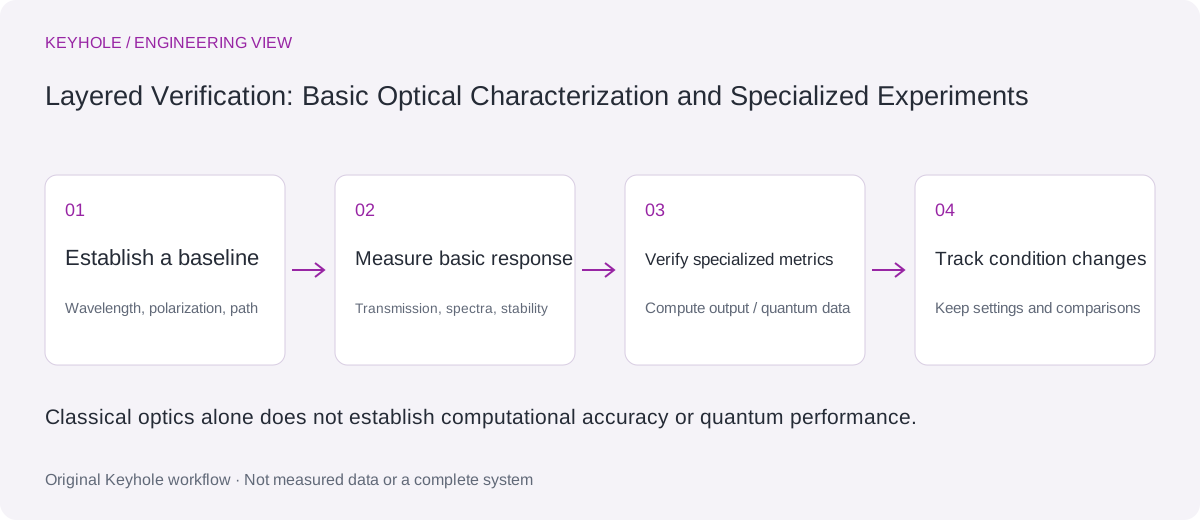
Classical Optical Compliance Does Not Establish Quantum Performance
Classical light can support some alignment, transmission and stability checks in quantum experiments. Single-photon statistics, interference quality and quantum states require appropriate sources, single-photon detectors, time tagging and specialized analysis.
Stable classical transmission does not establish quantum-gate fidelity, entanglement quality or single-photon performance. Reduced counts also should not be assigned to chip loss before checking input and detection paths.
If higher-power classical light establishes an operating point, verify transfer to actual experimental conditions. Power, thermal state and detection changes can limit applicability.
Start with a Repeatable Baseline
For a new experiment, record the operating band, input state, reference path, device configuration and environment, and obtain repeatable baseline responses. Retain corresponding records after program or access changes.
A baseline does not prove complete computational correctness. It provides a comparison for anomalies: check whether the basic path remains unchanged before investigating algorithms, detection statistics or specialized physics.
Define experiment objectives and observables before selecting tunable sources, optical characterization, polarization control and specialized equipment. A measurement platform may cover applicable foundational tasks, not complete photonic-computing or quantum-system acceptance.